
Your body already knows pH matters. Now your water can match.
Your stomach runs at pH 1.5. Your blood at 7.4. Every organ has its number.
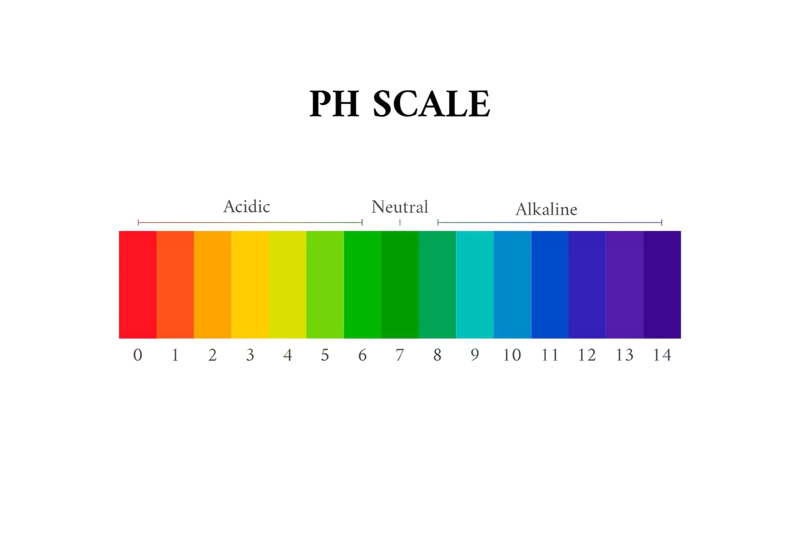
What pH actually means.
pH stands for "potential of hydrogen." It measures the concentration of hydrogen ions in a solution on a scale from 0 to 14. Below 7 is acidic. Above 7 is alkaline. Exactly 7 is neutral.
The scale is logarithmic — each whole number represents a tenfold difference. pH 6 is ten times more acidic than pH 7. pH 5 is a hundred times more acidic. This is why small shifts in pH matter far more than the numbers suggest.
Every liquid in your daily life sits somewhere on this scale. Orange juice at 3.5. Coffee at 5. Tap water at 6.5–7.5. Baking soda solution at 9. The question isn't whether pH matters — it's whether you're paying attention to it.
Nature has always made alkaline water.
Long before science measured pH, civilisations recognised that certain water sources were different. People travelled across continents to drink from them. Built temples around them. Called them sacred.
What these waters share — across geography, culture, and faith — is a naturally alkaline pH. The science behind their reverence was always there. We just didn't have the vocabulary for it.
Revered across Hinduism for millennia. Glacial meltwater flowing over mineral-rich Himalayan rock — naturally alkaline, naturally mineral-balanced. Millions undertake the pilgrimage to drink from the source.
Sacred in Islam for over 4,000 years. Naturally rich in calcium, magnesium, and fluoride. Pilgrims carry it home across continents. Studies confirm its consistently alkaline pH and unique mineral composition.
The "Royal Spring" — built by Mughal Emperor Shah Jahan in 1632. Believed to have medicinal properties. Locals and visitors have drunk from it for nearly 400 years. The water flows from a natural underground spring through limestone.
Home to one of the world's longest-living populations. Their glacial meltwater — milky white with suspended minerals — has been studied extensively. Alkaline pH, rich in colloidal minerals, and naturally hydrogen-bearing.
Different faiths. Different continents. Different centuries. The same water.
These sources have one thing in common: water that flows through mineral-rich rock for extended periods, naturally picking up alkaline minerals and restructuring itself. A SOMAWA ionizer recreates this process — not with rocks and centuries, but with platinum-titanium plates and electrolysis. Same result. Your kitchen counter.
Your body is a pH machine.
Every organ in your body maintains a specific pH — and defends it aggressively. This isn't optional biology. It's survival.
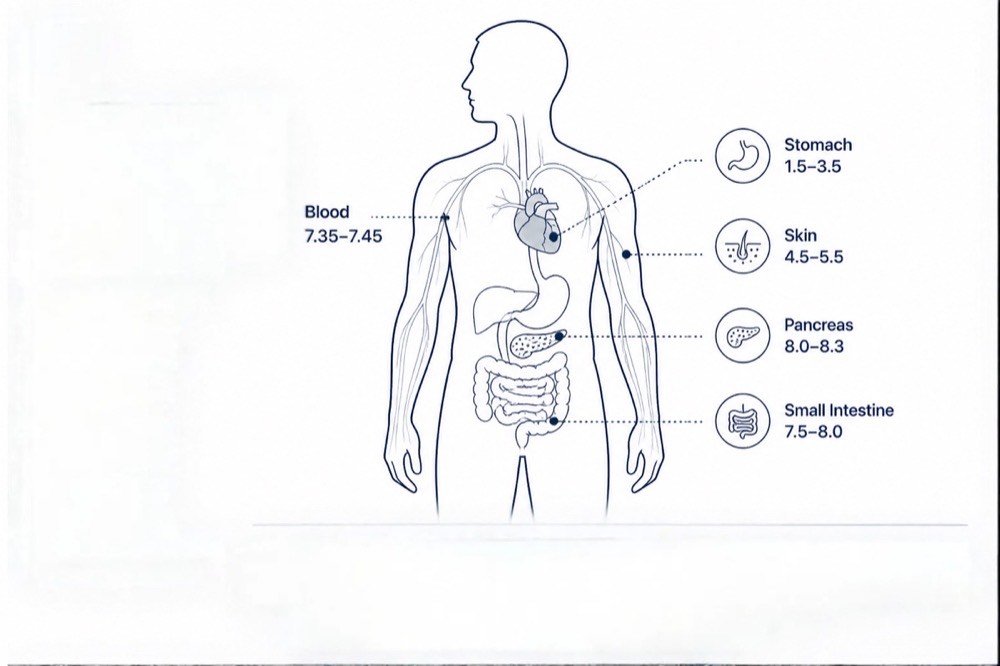
Stomach: pH 1.5 to 3.5 — intensely acidic. Breaks down food and kills bacteria. Your stomach is supposed to be acidic.
Blood: pH 7.35 to 7.45 — slightly alkaline. The body defends this range with extraordinary precision. A shift of just 0.1 outside this window is a medical emergency.
Skin: pH 4.5 to 5.5 — the acid mantle. Protects against bacteria and moisture loss.
Small intestine: pH 7.5 to 8.0 — alkaline. Where nutrients are absorbed.
The body doesn't have one pH. It has many — each precisely calibrated for a specific function.
Your body's buffering systems (bicarbonate, phosphate, protein buffers) work constantly to maintain these levels. Alkaline water doesn't override these systems — nothing you drink can change your blood pH. What it does is reduce the metabolic work required to maintain them.
What Warburg found. Nobel Prize, 1931.
Otto Warburg's Nobel Prize-recognised research established a foundational insight: the pH environment of cells matters at the biochemical level. His work on cellular respiration showed that the way cells produce energy is directly influenced by their oxygen and pH environment.
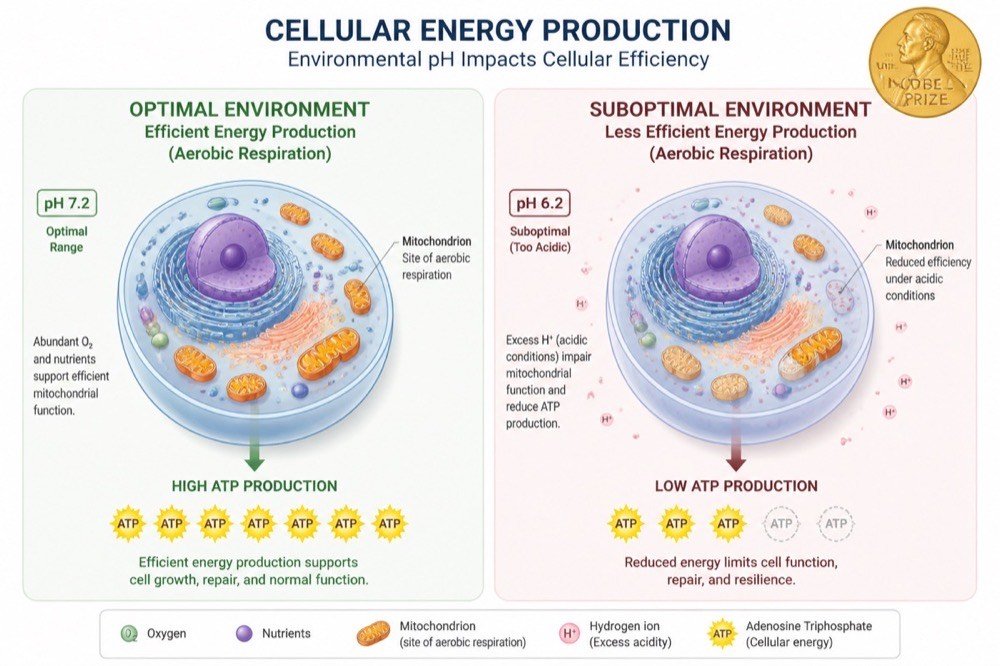
Warburg demonstrated that cellular oxygenation and the biochemical environment are interconnected — cells function differently depending on the conditions around them.
This doesn't mean alkaline water cures anything. It means the scientific community has recognised, for nearly a century, that pH at the cellular level is not trivial. It's fundamental biology.
The science is 95 years old. The application to drinking water is what's new.
What the WHO recommends — and what it doesn't tell you.
The World Health Organization recommends drinking water in the pH range of 6.5 to 8.5. India's Ministry of Jal Shakti follows the same guideline.
But here's the context most people miss: the WHO sets a global minimum. Their guidelines are designed to cover the entire planet — including regions facing drought, water scarcity, and contamination crises. The floor is set at 6.5 because below that, water corrodes pipes and leaches heavy metals. The ceiling at 8.5 is about distribution infrastructure, not human biology.
In other words, 6.5 is the survival threshold — not the optimal range.
RO water in most Indian homes sits below pH 7 — technically it can be within the WHO range, but still on the acidic side of neutral. It passes the global safety floor. But is the global safety floor really the standard you want for your family's daily water?
Consider what's changed: our diets have shifted dramatically toward acidic intake — processed food, refined sugar, carbonated drinks, excessive caffeine, red meat. The body's buffering systems are working harder than they ever had to. In this context, drinking water that barely clears the acidic line isn't helping — it's adding to the load.
The WHO guideline tells you what won't harm you. It doesn't tell you what will serve you.
SOMAWA's alkaline drinking setting (pH 8.5) sits in the same territory as natural mountain spring water — the water human biology evolved with for millennia, long before processed food existed.
The Indian water reality.
India's municipal water varies enormously. TDS in Mumbai averages 60–70. In Jodhpur, 400. In Chennai, 200. pH varies just as widely — and after RO treatment, it almost always drops into the acidic range.
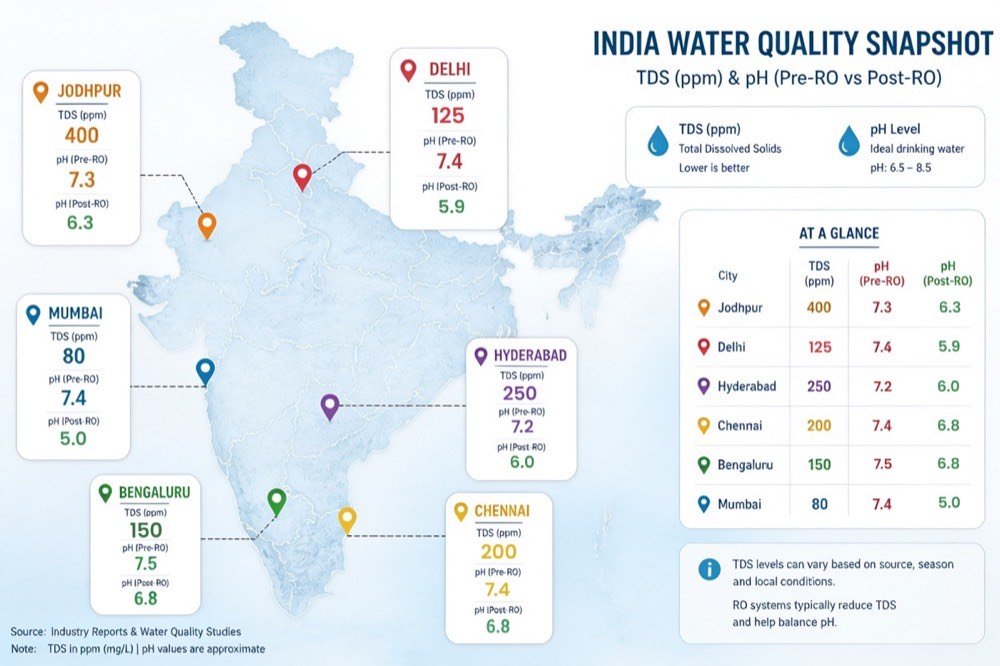
The problem isn't that RO is bad. The problem is that most homes stop at RO. The purification is done. The restructuring never happens.
A SOMAWA ionizer installs after your RO (or directly on the tap, depending on TDS). It takes clean, flat, acidic RO water and restructures it — raising pH, dissolving molecular hydrogen, shifting ORP negative. The water that was safe becomes the water that was always meant to be.
250 million Indian homes have an RO. Almost none have what comes after it.
Why selectable pH changes everything.
Most alkaline water devices produce one pH. You get what you get. A SOMAWA ionizer gives you the full spectrum — pH 3.5 to pH 10.5, selectable at the touch of a button.

This matters because different applications need different pH levels:
- pH 8.5–9.5 — Daily drinking, cooking, tea and coffee
- pH 5.5 — Facial toner, hair rinse (mirrors skin's acid mantle)
- pH 10.5 — Pesticide residue removal, natural degreaser
- pH 3.5 — Surface sanitizing (not for consumption)
- pH 7.0 — Time-release medications, infant formula
One machine. Five distinct water types. Every room in your house. This is what selectable pH means in practice — not a gimmick, but genuine utility across your entire household.
Key references.
- Warburg, O. "The Metabolism of Tumours." Nobel Prize-recognised research on cellular oxygenation and pH regulation (1931).
- WHO/Ministry of Jal Shakti — Drinking Water Quality Guidelines, pH 6.5–8.5 recommendation.
- ICMR-INDIAB — Indian Council of Medical Research, India Diabetes Study data on metabolic health trends.
- Shirahata, S. et al. "Electrolyzed-reduced water scavenges active oxygen species and protects DNA from oxidative damage." Biochem Biophys Res Commun 234(1), 269–274 (1997).
- Hanaoka, K. et al. "The mechanism of the enhanced antioxidant effects against superoxide anion radicals of reduced water produced by electrolysis." Biophysical Chemistry 107, 71–82 (2004).
The next step is a conversation.
A fifteen-minute consultation. No pressure, no commitment.
Reserve Your Consultation CallIndividual experience. Outcomes vary by person, condition, and lifestyle. Somawa products are wellness devices, not medical treatments.