
A lake heals itself. So does your body.
The mechanism behind both is the same. And it's measurable.

How a lake stays alive.
Pour pollutants into a healthy lake. Come back in a few months. The lake has cleaned itself. Not perfectly — there are limits — but the self-correction is real and observable.
Ecologists have studied this for decades. A healthy lake maintains what they call a redox equilibrium — a balance between oxidation and reduction at the molecular level. This equilibrium is what allows the ecosystem to neutralise threats, break down contaminants, and sustain life.
When that balance is disrupted beyond the lake's capacity — too much pollution, too much chemical runoff, prolonged stagnation — the water loses its ability to self-correct. The ecosystem collapses. The water becomes dead.
The difference between a living lake and a dead one isn't what's in the water. It's the water's ability to restore itself.
Scientists measure this self-healing capacity with a single number. They dip a probe into the water and read the electrical charge — measured in millivolts. A healthy, self-restoring lake carries a negative charge. A stagnant, dying lake carries a positive charge.
That measurement has a name. It's called ORP — Oxidation-Reduction Potential.
Your body does the same thing.
This is not a metaphor. The same electrochemical mechanism that allows a lake to self-heal operates inside your body — right now, as you read this.
Your blood, your intracellular fluid, your cerebrospinal fluid — all carry a negative electrical charge. This isn't incidental. It's how your body maintains its own redox equilibrium. It's how your cells neutralise oxidative stress, repair damage, and stay functional.
When your body's redox balance tips too far toward the oxidative (positive) side — from stress, processed food, pollution, poor sleep — the self-healing slows down. The system still works, but it's working harder. The lake is struggling.
When the balance is restored — when the internal environment returns to the reductive (negative) side — the body's natural repair mechanisms operate without resistance. The lake is healthy again.
A healthy lake and a healthy body have the same electrical signature: a negative charge.
Now measure the water you drink.
Here's where it gets personal. The same ORP measurement that ecologists use on lakes, you can use on a glass of water. Dip the probe in. Read the number.
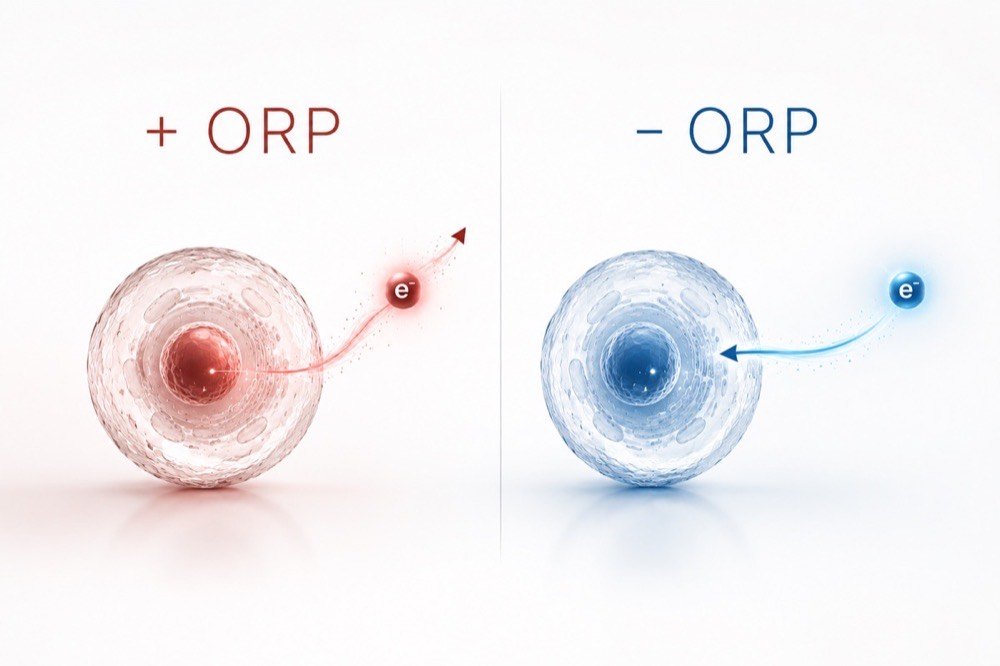
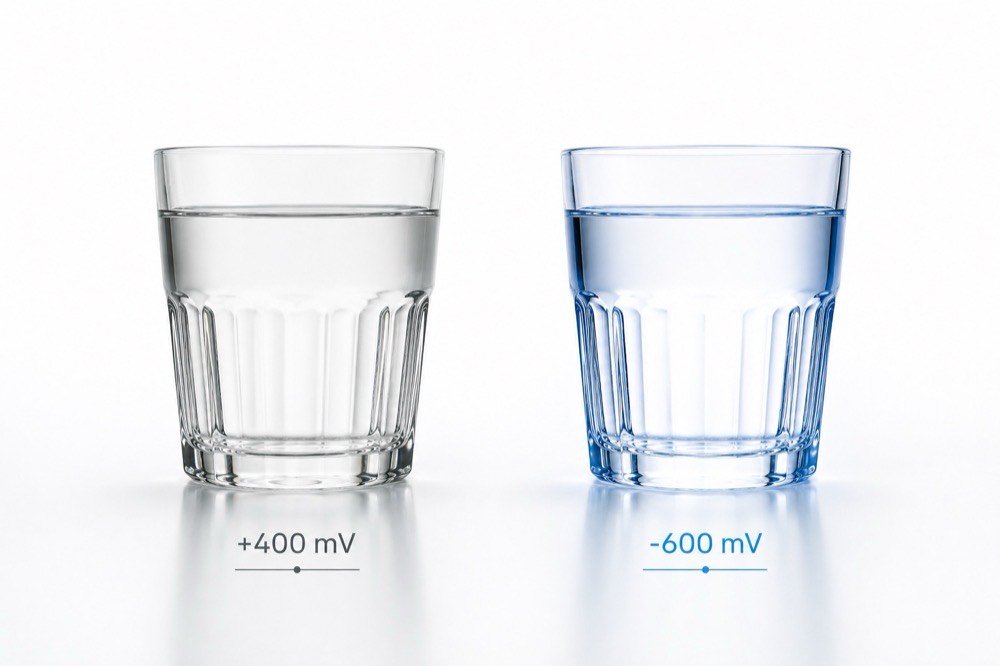
Positive ORP means the water takes electrons from what it touches. It oxidises. Your body has to neutralise this charge before the water is useful — it's extra work for an already busy system.
Negative ORP means the water gives electrons. It reduces. It arrives in a state that already matches your body's own electrochemical environment. Alignment instead of resistance.
Your tap water? Typically +200 to +600 mV. Your RO water? +200 to +400 mV. Bottled water? About the same. Every glass, every day, on the wrong side of the equation.
Sacred springs knew this first.
Long before ORP meters existed, people walked hundreds of kilometres to drink from specific water sources. Gangotri. Hunza Valley. Zamzam. Different faiths. Different centuries. But when scientists finally measured these waters, they found the same thing every time: a negative charge, and elevated dissolved hydrogen.

Gangotri
pH 8.0–8.5 · Glacial source, Uttarakhand

Hunza Valley
pH 8.0–9.0 · Glacial meltwater, Gilgit-Baltistan

Zamzam
pH 7.9–8.0 · Masjid al-Haram, Makkah
What made these springs different wasn't mystical. It was measurable. The water carried a negative charge — the same signature as a healthy lake, the same signature as a healthy body.
The numbers, side by side.
Every water source has an ORP. The numbers are not controversial — they're measurable with a standard ORP meter you can buy online for a few thousand rupees.
The difference is not subtle.
Alignment vs. resistance.
Think of it this way. Your body's internal environment runs at a negative charge. Every glass of water you drink arrives with its own charge. If that charge is positive (+300, +400 mV), your body has to work to neutralise it before the water is useful. Your antioxidant systems kick in. Resources are spent. It's not harmful — your body handles it — but it's unnecessary work. Every glass, every day.
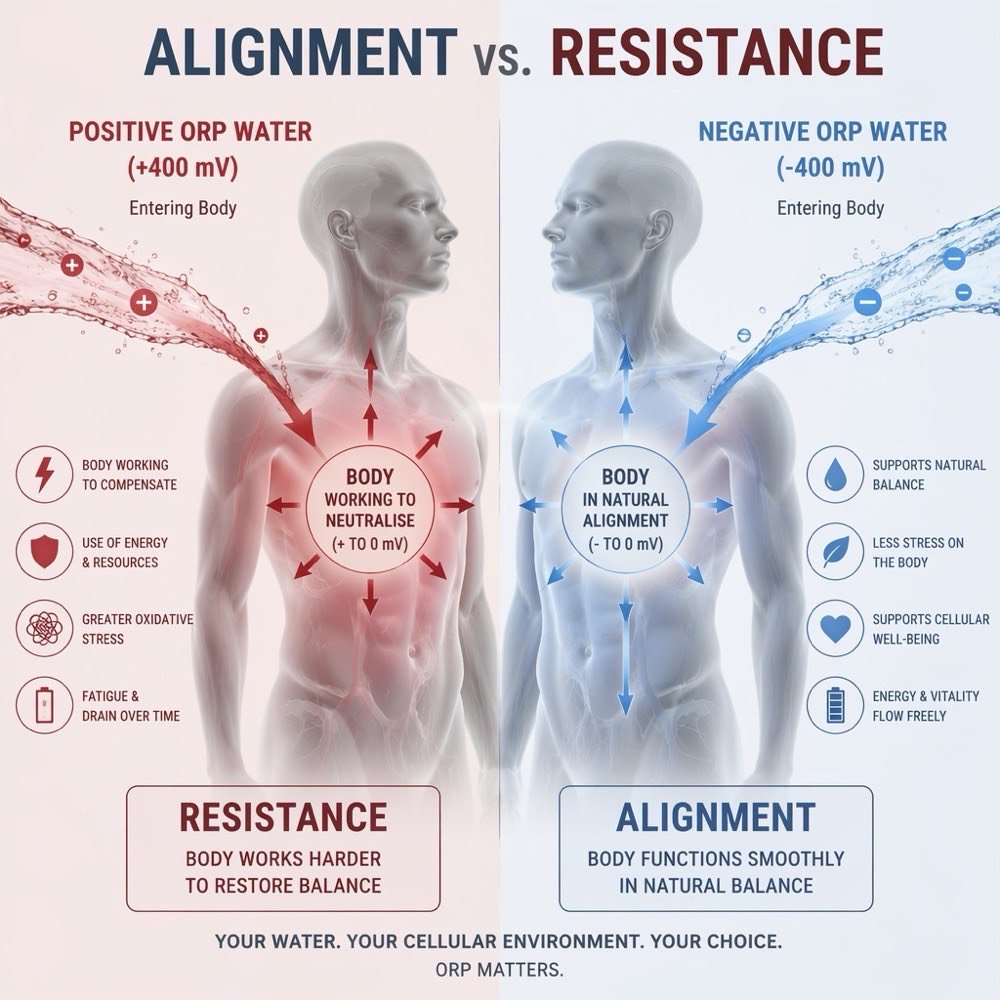
If the water arrives already carrying a negative charge (-200, -400, -600 mV), that work is already done. The water aligns with your body's electrochemistry instead of working against it. The lake stays healthy. The system runs without friction.
This is what many SOMAWA customers describe — not a dramatic event, but a quiet reduction in the body's background workload. Research suggests that this alignment may support the body's natural antioxidant defences, though individual experiences vary.
But not all negative charge is safe.
This is the one nuance most people miss. A negative ORP number alone doesn't mean the water is good for you. What matters is what's producing the charge.
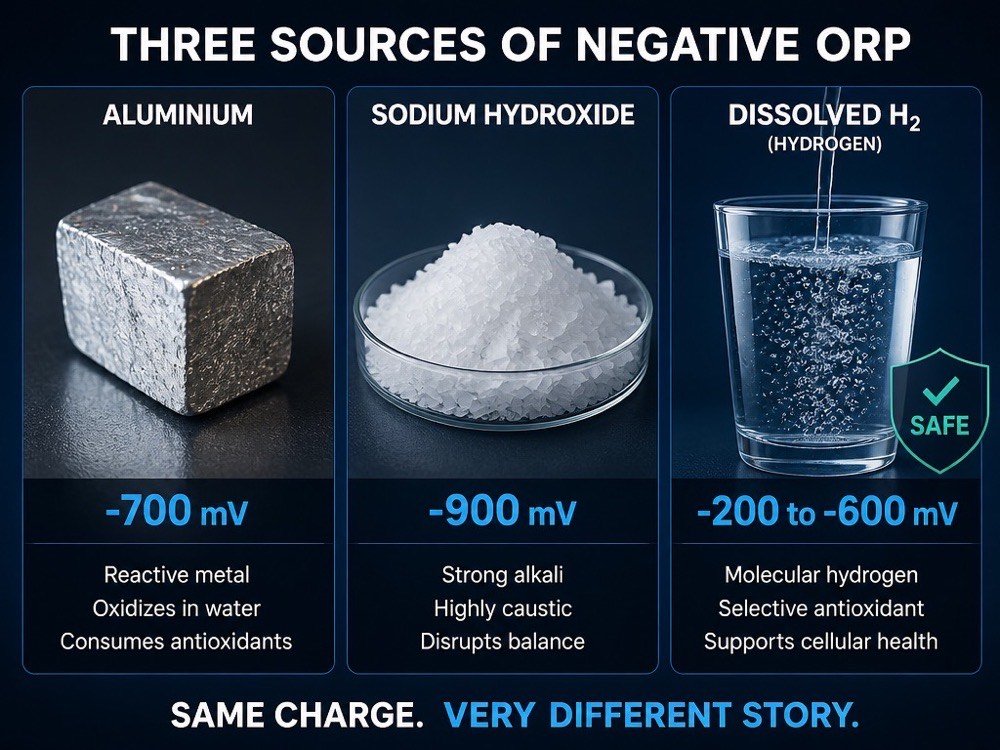
Aluminum dissolved in water can produce an ORP of -700 mV. Sodium hydroxide can push ORP to -900 mV. Neither is something you want to drink.
SOMAWA's negative ORP comes from dissolved molecular hydrogen — the verified selective antioxidant with 1,300+ peer-reviewed studies and zero known side effects. The molecule producing the charge is as important as the charge itself.
Don't ask "what's the ORP?" Ask "what's making the ORP?"
One transformation. Three measurements.
pH, molecular hydrogen, and ORP are not three separate features. They are three ways of measuring the same restructuring — the same transformation that happens when water flows over mineral-rich bedrock in a mountain spring.
When water passes through electrolysis over platinum-titanium plates, the restructuring shifts all three simultaneously: pH moves alkaline, dissolved hydrogen increases, ORP drops negative. You can't change one without changing the others — they're interconnected expressions of the same physics.
This is why a hydrogen-only bottle or an alkaline-only filter can't replicate what a full electrolysis ioniser does. Partial restructuring gives you one property. Full electrolysis gives you all three, stacked in every glass.
Key studies.
- Shirahata, S. et al. "Electrolyzed-reduced water scavenges active oxygen species and protects DNA from oxidative damage." Biochem Biophys Res Commun 234(1), 269–274 (1997).
- Lee, M.Y. et al. "Electrolyzed-reduced water protects against oxidative damage to DNA, RNA, and protein." Appl Biochem Biotechnol 135, 133–144 (2006).
- Hanaoka, K. et al. "The mechanism of the enhanced antioxidant effects against superoxide anion radicals of reduced water produced by electrolysis." Biophysical Chemistry 107, 71–82 (2004).
- Ohsawa, I. et al. "Hydrogen acts as a therapeutic antioxidant by selectively reducing cytotoxic oxygen radicals." Nature Medicine 13, 688–694 (2007).
The next step is a conversation.
A fifteen-minute consultation. No pressure, no commitment.
Reserve Your Consultation CallIndividual experience. Outcomes vary by person, condition, and lifestyle. Somawa products are wellness devices, not medical treatments.