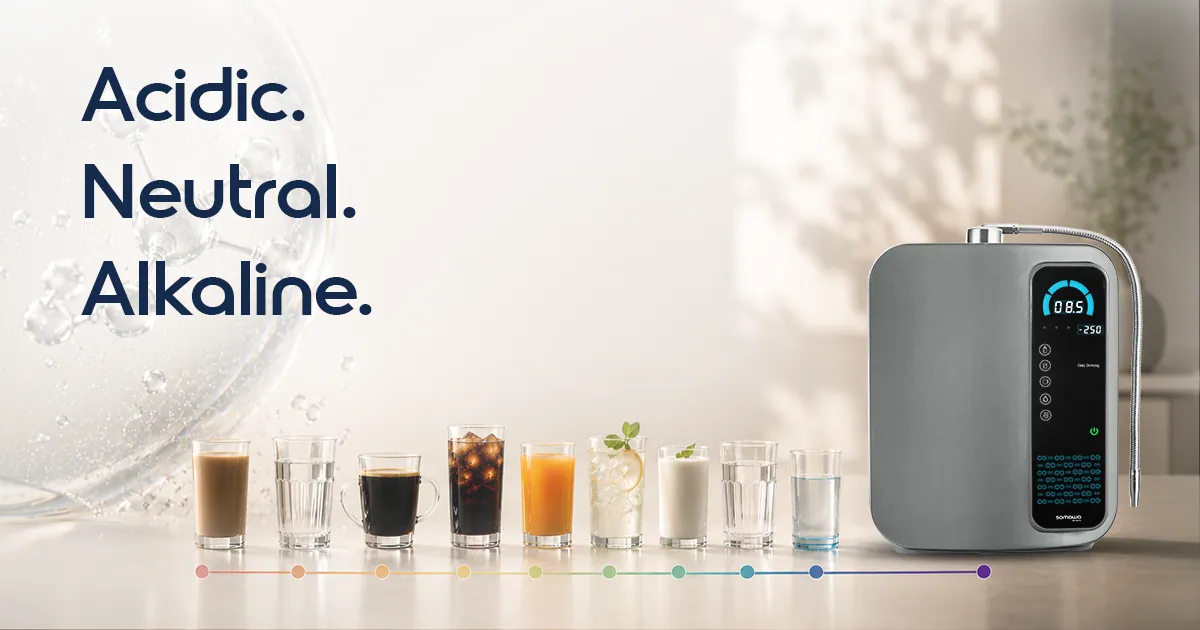
The ideal pH for drinking water is mildly alkaline, about 8.5–9.5 — the range of mountain spring water.
Ask anyone the ideal pH of drinking water. You will get a shrug. Maybe a memory of a school chemistry class where 7 was neutral.
Yet pH runs through every sip of an ordinary Indian day. The morning chai. The RO water at your desk. The cola with lunch. The evening coffee.
Each one has a number. Nobody has ever put them in a row.
So let us put them in a row.
What is the ideal pH of drinking water?
8.5 to 9.5. Mildly alkaline. The range mountain spring water sits in naturally.
Note the word range. This is not a contest where higher wins.
Tap water sits near neutral. RO water lands below 7 — on the acidic side. Most people who own an RO have never been told this.
A day in drinks
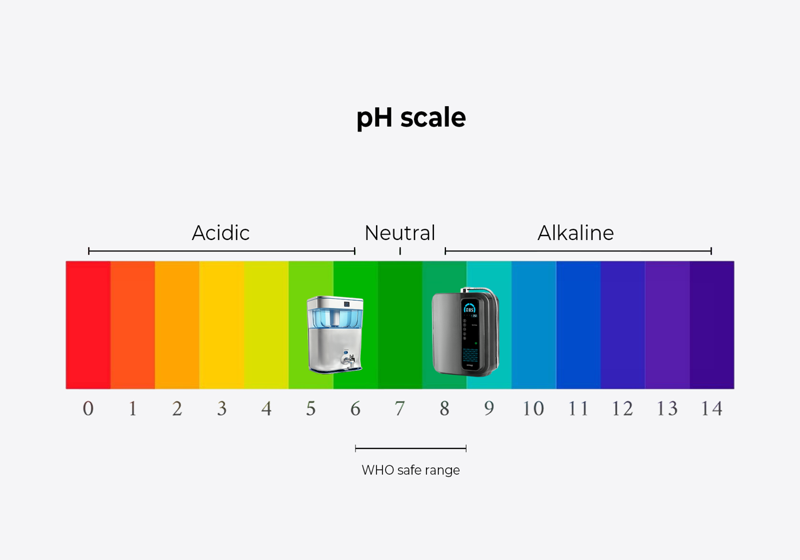
The pH scale runs 0 to 14. It is logarithmic. Each step down is ten times more acidic than the last.

Everything below the dotted line is acidic. One line on this chart is the one you drink most — and the only one you can actually move.
So a cola at 2.5 is not "a bit" more acidic than water at 7. It is tens of thousands of times more acidic.
Now, the day:
| Time | Drink | pH |
|---|---|---|
| 7 AM | Milk chai | 6.2 – 6.8 |
| 9 AM | RO water | 5.5 – 6.5 |
| 11 AM | Black coffee | 4.8 – 5.1 |
| 1 PM | Cola | 2.3 – 2.5 |
| 2 PM | Packaged juice | 3.3 – 4.0 |
| 4 PM | Nimbu paani | 2.5 – 3.0 |
| 6 PM | Chaas | 4.4 – 4.8 |
| 9 PM | RO water again | 5.5 – 6.5 |
| Neutral | 7.0 | |
| Ionized water | 8.5 – 9.5 |
Read it twice.
From the first chai to the last glass at night, almost everything sits below 7. A sensible, health-conscious Indian day is an acidic day. Not because of the indulgences. Including the water.
This table is not an accusation. Chaas has been part of Indian life for centuries. Nimbu paani is not a villain.
It is an inventory. And it shows one thing clearly.
The drink you consume most — water, two or three litres a day — is the only line you can actually move.
Is RO water acidic?
Usually. Mildly. Around 5.5 to 6.5.
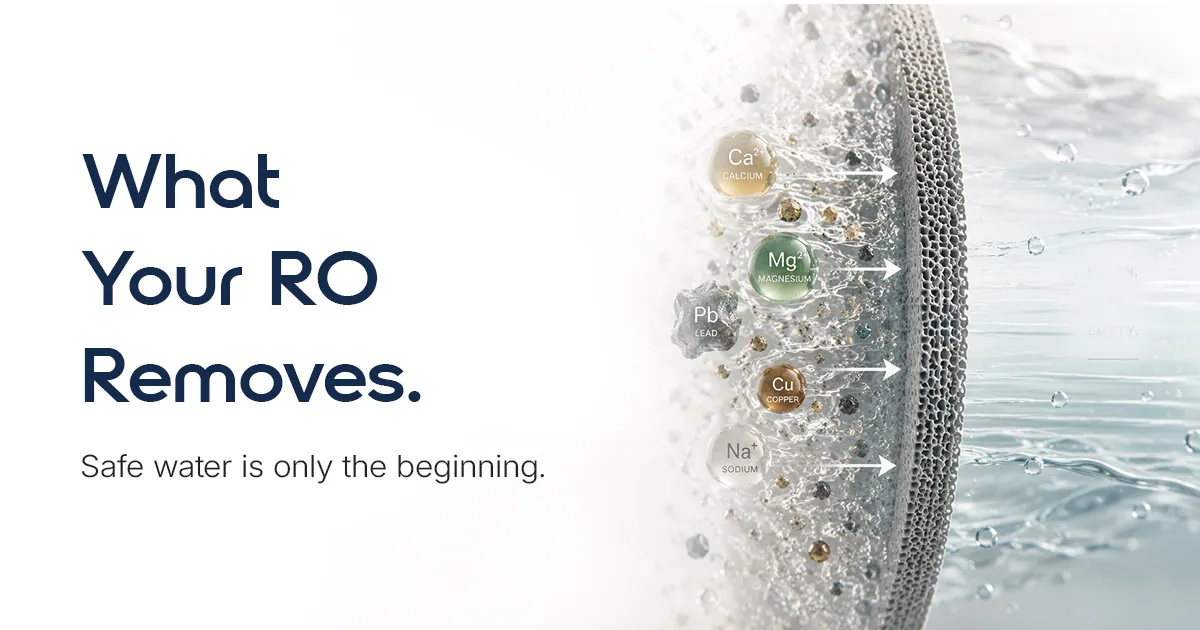
RO strips dissolved minerals. Mineral-poor water drifts acidic. The machine that made your water safe also, quietly, moved it down the table.
Most owners have never measured this. The TDS pen they were handed does not measure it.
Doesn't the body regulate its own pH?
Yes. And an honest article has to start there.

Your blood pH holds between 7.35 and 7.45. Your body defends that range with lungs, kidneys and chemical buffers, working every second.
Drinking alkaline water does not change your blood pH. It doesn't. Anyone who tells you otherwise is selling, not explaining.
So the real conversation is not about override. It is about workload.
Your body will hold its balance regardless. The question is what you make it hold that balance against — glass after glass, year after year.
Water arrives on one side of the ledger or the other. One side asks something of the body. The other doesn't.
That is the whole case. Unexaggerated. No more than that.
It is also why Somawa machines hold the 8.5–9.5 range for drinking, rather than chasing impressive-sounding extremes. Our ionizers are incubated under NRDC — Ministry of Science & Technology, Government of India. Range, not maximum. That discipline runs through the engineering.
Is higher pH always better?
No. This is where nonsense enters the category.
pH 11 water is not "more healthy" than pH 9 water. It is a different substance with a different job. It does not belong in a drinking glass.
High-pH water has real uses. Washing produce. Cleaning surfaces. A well-built ionizer gives you those settings separately — precisely because they are not for drinking.
The drinking range is 8.5 to 9.5.
A machine that boasts about how far past that it can go is telling you about its marketing, not its engineering.
And "alkaline" on a bottle label is not information. It is a word. The number, the mechanism and the freshness are the story.
How do you find your own water's pH?
Not from this article. From a measurement.
Your pH depends on your city, your source, your tank, your RO. The only number that matters is the one at your tap.
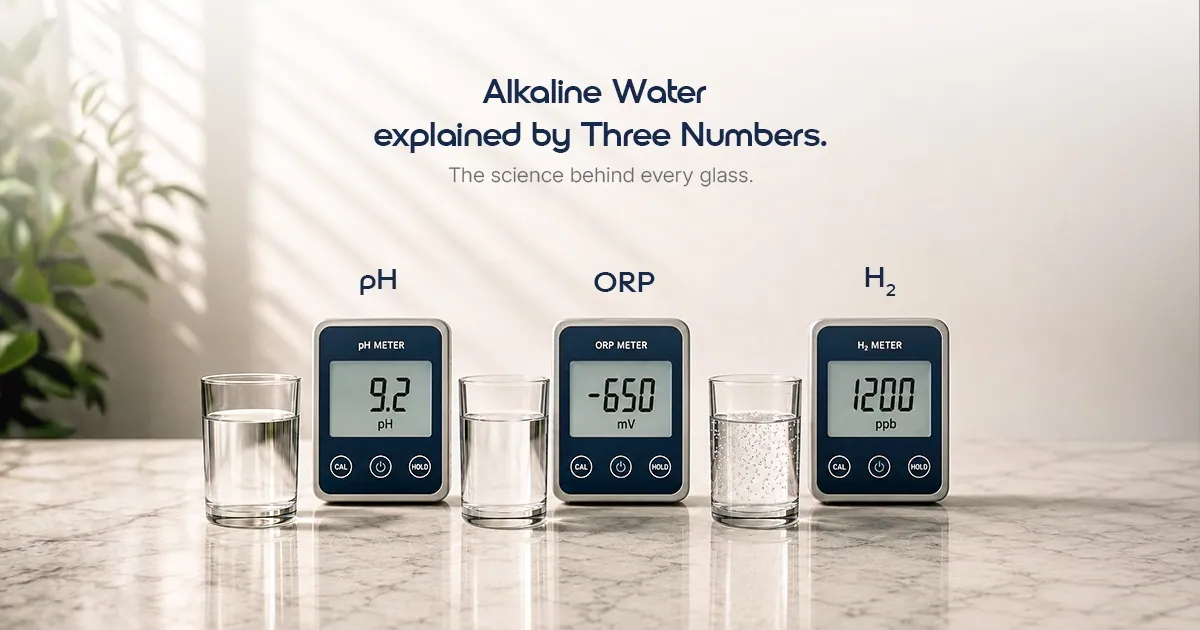
A proper test reads pH, TDS and ORP together, in one sitting.
If ORP is a new word, it may be the most interesting of the three: What Is ORP — and Why Your Water's Number Is Probably Positive.
If you're curious what your tap reads, a free home test takes 15 minutes.
Most people upgrade their water after a diagnosis. Some decide before one.
Knowing your numbers is the smallest possible version of deciding before.
Questions people actually ask
What is the pH of normal tap water in India?
Most Indian tap water sits between about pH 6.5 and 8.5, depending on the source and treatment. Municipal water is usually kept near neutral to mildly alkaline, while borewell water varies widely. The BIS acceptable range for drinking water is pH 6.5 to 8.5, so tap water is typically within limits — though that says nothing about its ORP or hydrogen.
What is the pH of bottled or packaged drinking water?
Most packaged still water in India is roughly pH 6.0 to 7.5 — near neutral to slightly acidic. Bottles labelled 'alkaline' are usually mineral-adjusted to a higher pH. Either way, bottled water is optimised for shelf stability, not for ORP or dissolved hydrogen, which do not survive bottling.
Can drinking alkaline water change your body's pH?
No — your blood pH is held in a tight range of about 7.35 to 7.45 by your kidneys and lungs, and drinking-water pH does not move it. Stomach acid neutralises the incoming water's pH quickly. The 'alkalise your body' pitch is the least defensible part of alkaline-water marketing, so treat body-pH claims as a red flag. The measurable, honest properties are pH, ORP and hydrogen in the glass — not in your bloodstream.
What pH is too acidic or too alkaline to drink?
India's BIS standard puts the acceptable drinking-water range at pH 6.5 to 8.5. Water far below that can taste sour and be more corrosive to plumbing; water far above can taste soapy or bitter. Ionised drinking water is usually offered in a selectable 8.5 to 9.5 band, with the strongest settings meant for cleaning rather than drinking.
What is the safe pH range for drinking water?
The BIS (IS 10500) acceptable range is pH 6.5 to 8.5; the WHO does not set a strict health-based pH limit but notes similar practical bounds. Within that range, pH itself is largely a matter of taste and plumbing. It is one of three water properties worth knowing, alongside ORP and dissolved hydrogen.
How do you increase the pH of drinking water?
You can nudge pH up by adding minerals — a pinch of bicarbonate, mineral drops, or an alkaline filter — or reach and hold a higher pH consistently with electrolysis in a water ioniser. The difference is that mineral tricks only change pH, while electrolysis also drives ORP negative and adds dissolved hydrogen, and holds all three steadily.
Is higher-pH water safe to drink every day?
Mildly alkaline water in the roughly 8.5 to 9.5 range is consumed daily by many people and sits within common practical limits. Very high pH settings on an ioniser are intended for cleaning, not drinking. Individual experience varies; if you have a specific medical condition, check with your doctor. SOMAWA machines are wellness devices, not medical treatments.
Does acidic drinking water harm you?
Mildly acidic water within the BIS range is generally safe to drink; the bigger practical concern is that low-pH water is more corrosive to pipes and can pick up metals. That is about plumbing and taste, not a direct toxin. If your water is very acidic, the fix is proper filtration and, if you want it, restructuring — not worry about the pH number alone.
पीने के पानी का सही pH कितना होना चाहिए?
भारत में BIS मानक के अनुसार पीने के पानी का pH 6.5 से 8.5 के बीच होना चाहिए। इस दायरे में pH ज़्यादातर स्वाद और plumbing की बात है। Ionised पानी आमतौर पर 8.5–9.5 के चुनने-लायक स्तर पर दिया जाता है। pH के साथ ORP और dissolved hydrogen को जानना भी ज़रूरी है।
क्या alkaline पानी शरीर का pH बदल सकता है?
नहीं — आपके खून का pH किडनी और फेफड़े एक तय दायरे (लगभग 7.35–7.45) में बनाए रखते हैं, और पीने के पानी का pH इसे नहीं बदलता। 'शरीर को alkaline करने' वाला दावा alkaline-water marketing का सबसे कमज़ोर हिस्सा है। असली, मापने लायक गुण हैं pH, ORP और hydrogen — गिलास में, खून में नहीं।
The SOMAWA range
 Amara
Amara
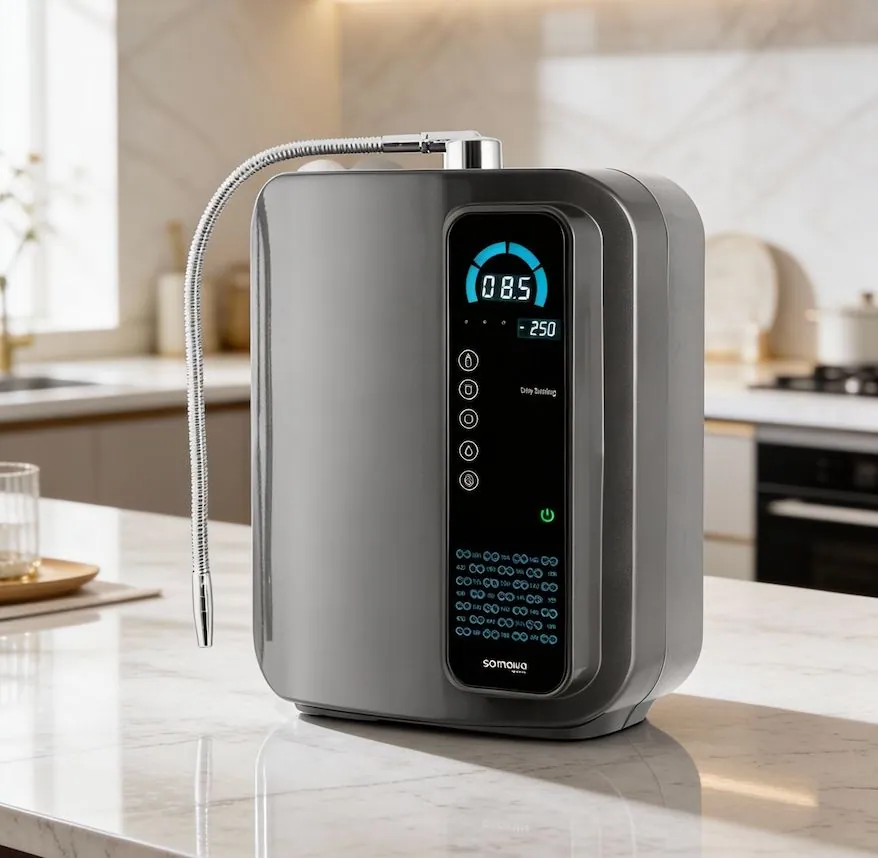
Pipeless AFS design. Think beyond health.
Learn more →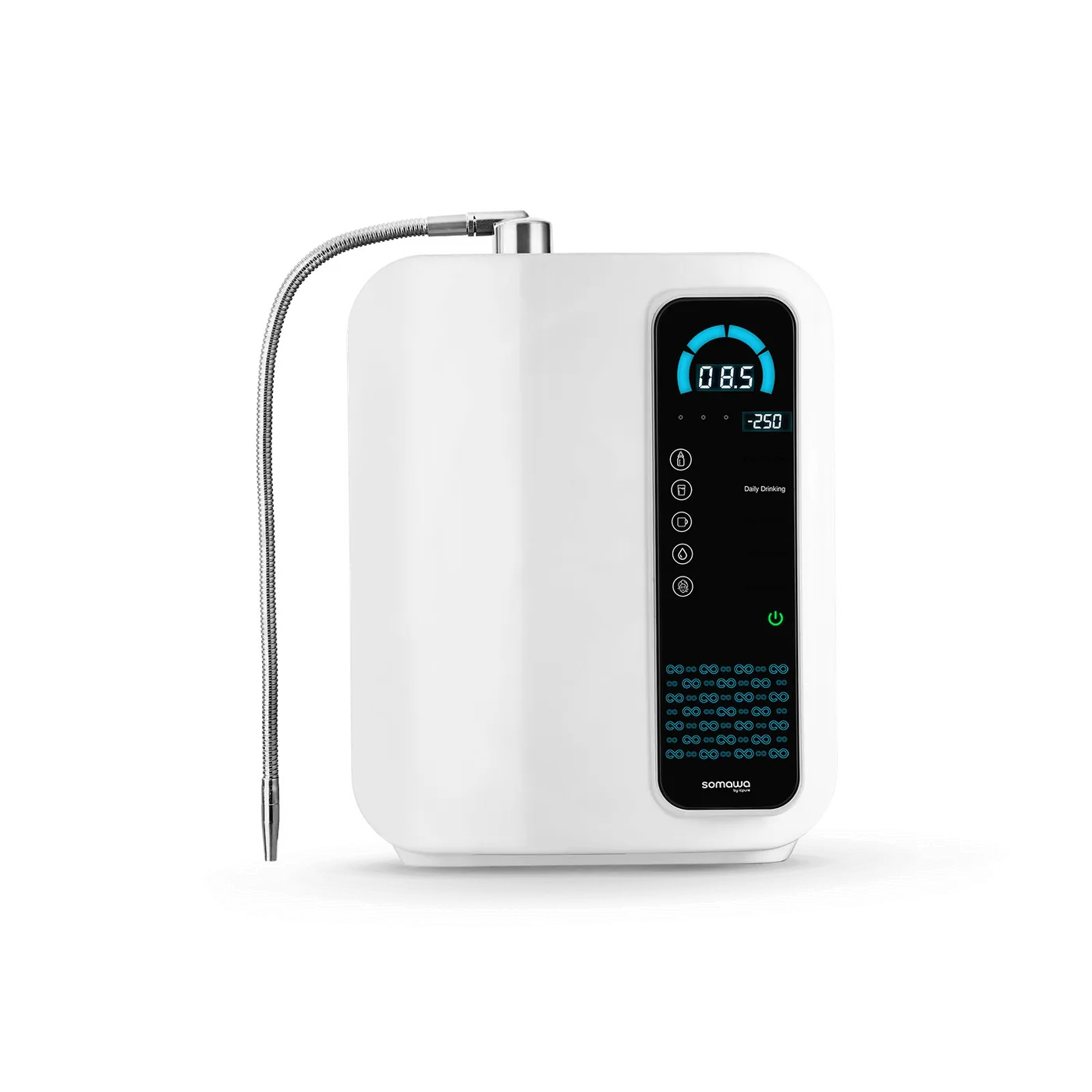 Amara NXT
The Amara platform, taken further.
Learn more →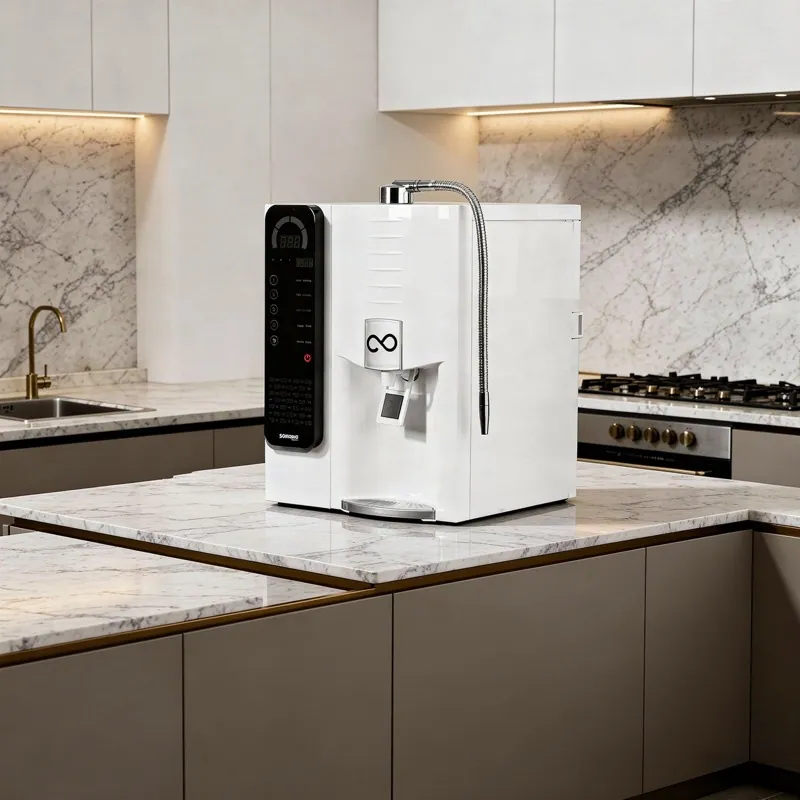 Udaka
Udaka
Built-in RO and ionisation in one unit.
Learn more →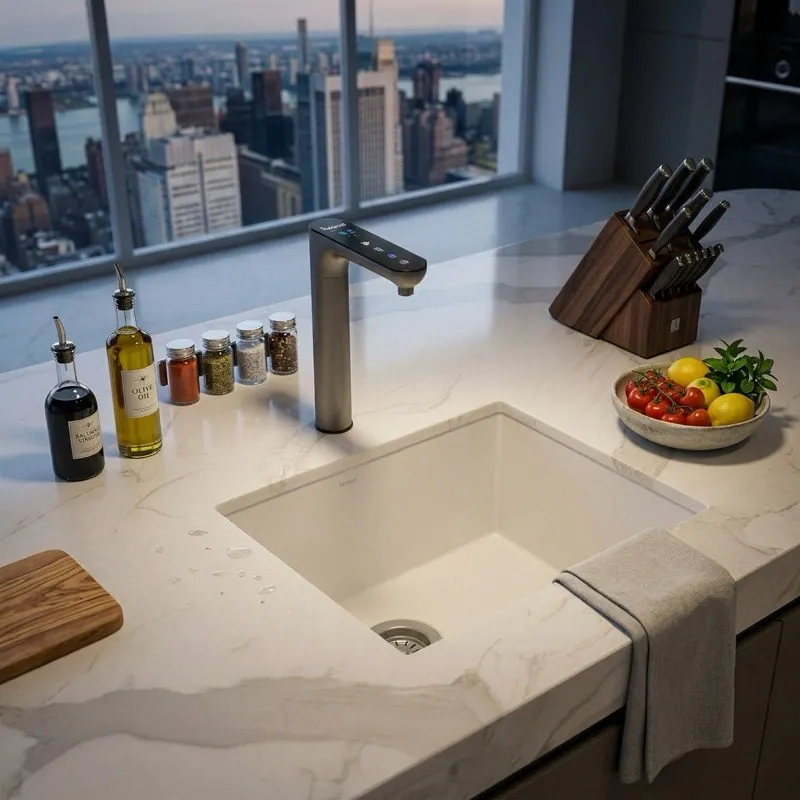 Modish
Nine plates. Designed to make a difference.
Learn more →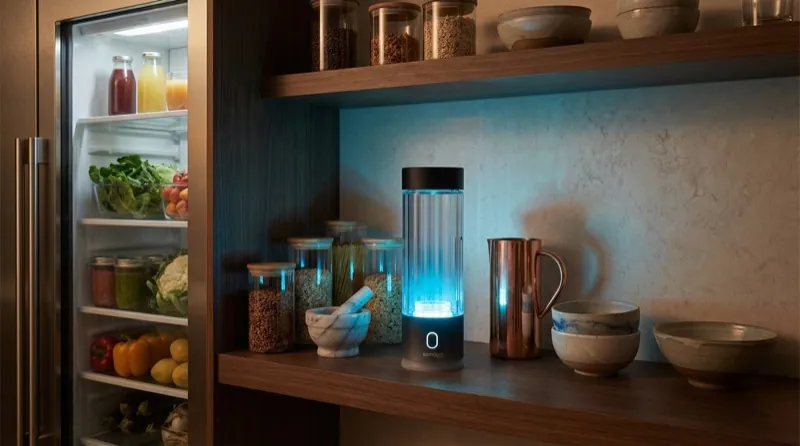 Toya
Toya
Experiential water. Infuses life in every drop.
Learn more →SOMAWA products are wellness devices, not medical treatments. Nothing on this page is medical advice. Customer experiences are individual and vary; they are shared as wellness outcomes, not clinical results. Research cited is indexed with DOIs where available. SOMAWA is incubated under NRDC, an enterprise of DSIR, Ministry of Science and Technology, Government of India.